Why We Are Drawn to Competition, Risk, and Reward
August 17, 2026
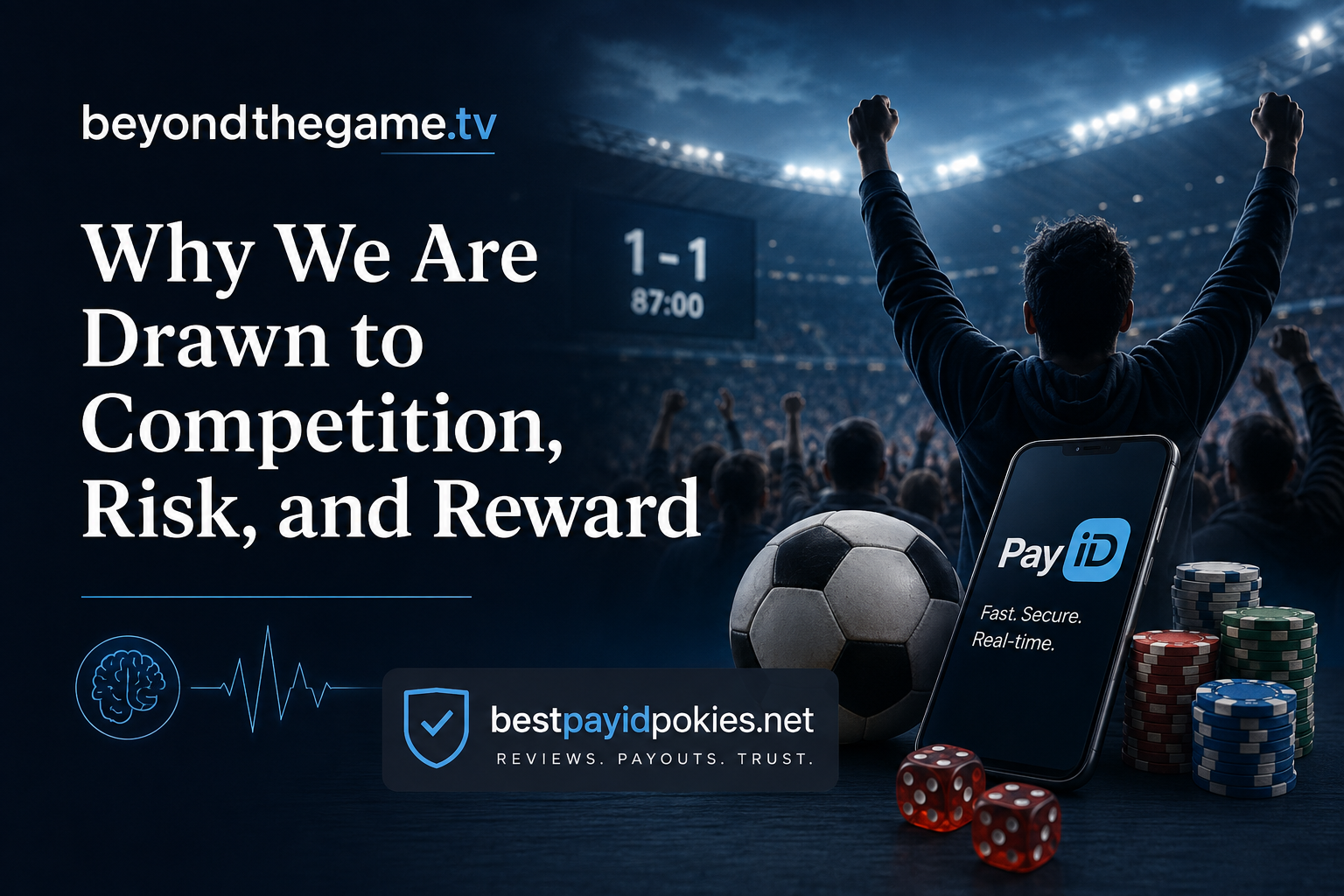
Watch a stadium when the match is level with three minutes left. Nobody checks the exit, nobody looks at a watch, and the noise changes shape. That same crowd would have drifted out twenty minutes earlier had the score been 4-0. Sport has built stadiums, broadcast contracts, and national calendars on one behavioural fact: attention sharpens when an outcome is still genuinely in play. What deserves a closer look is what the brain does during those three minutes — and why the same machinery appears in a training session, a fantasy league, and a card game.
Anticipation Arrives Long Before the Result
Dopamine's reputation as the pleasure chemical undersells it; the research reads closer to bookkeeping. These neurons fire in proportion to the gap between what was expected and what happened, and Fiorillo, Tobler and Schultz reported in Science in 2003 that they also produce a slow, building signal in the seconds before a possible reward. That signal peaks when the chance of getting it sits around fifty-fifty — the point where uncertainty is mathematically at its maximum.
Translate that into a scoreline. A one-goal lead in the 85th minute is close to a coin flip, and attention stays at full stretch until the question resolves. A four-goal lead answers it early, the signal fades, and so does the crowd. Late collapses, playoff races, and final-day permutations — the stories that fill beyondthegame.tv — hold audiences that routine wins cannot match.
Suspense Is the Product a League Actually Sells
Sports economists have argued about this for seventy years. Rottenberg's 1956 uncertainty of outcome hypothesis proposed that tighter competition draws bigger crowds, and the evidence has stayed mixed ever since, partly because partisan fans enjoy watching their own side dominate. Recent work is sharper. Modelling minute-by-minute television audiences for English Premier League matches, researchers found that viewing tracks suspense and surprise as win probabilities shift during play, along with the shock of a result diverging from pre-match expectations.
Audiences follow the movement of probability more than the movement of the ball, which is why relegation battles get marketed as hard as title races.
A Stake Turns a Spectator Into a Participant
Watching is one thing; having something on the line is another. Prospect theory — the work behind Daniel Kahneman's 2002 Nobel Memorial Prize in Economics — showed that losses weigh more heavily than equivalent gains. Once a person holds a stake, the outcome stops being information and becomes personal. A Sunday league defender playing for promotion reads the game differently from the same player in a friendly.
What has to be true before a contest genuinely grips us:
The result is still in doubt at the moment we start paying attention
A clock, a distance, or a final round forces the question to be settled
Something is at stake — allegiance, reputation, effort already spent, or money
The rules are visible and identical for everyone taking part
The outcome arrives soon enough to feel connected to the action that produced it
Remove any one and engagement drops fast: a fixed match fails the fourth condition, a dead rubber the first.
How Fast the Reward Lands Changes How It Feels
That final condition is the one most often overlooked. Delay discounting explains it: the longer the gap between an action and its payoff, the weaker the link feels. A goal roared the instant the ball crossed the line lands differently from one confirmed by review ninety seconds later, though the scoreboard reads the same.
Competition also grips harder when there is something concrete to win, which is why so much modern play is built around visible rewards. Ladder rankings, weekly tournaments, achievement tiers and prize pools borrow their architecture from sport almost wholesale, because it works on the same wiring: a leaderboard is a league table with the season compressed into a week.
Reward psychology does not stop at the moment of winning, though. How soon the prize turns into something a person can actually use carries its own weight — a trophy lifted on the pitch and the same trophy posted out six weeks later are, in experience if not in value, two different objects.
Money follows that rule closely, and for Australian players PayID makes the point neatly. Transfers settle in near real time rather than overnight; they run at weekends and on public holidays instead of pausing until Monday, a phone number or email address replaces BSB and account digits, and the registered account name appears on screen before anything is confirmed. The payment step ends up moving at roughly the speed of the contest that produced it, rather than trailing several days behind. Set against three to five business days for a card withdrawal, that gap is felt rather than calculated, which is why cashout speed deserves weighing alongside bonuses and game libraries. Any PayID casino can advertise instant payouts; whether the money arrives that way is a separate matter, and players are usually the ones who find out. bestpayidpokies.net collects the stated processing windows operator by operator, and its Trustpilot profile records how those windows held up for the people who tested them.
Why the Same Question Works Every Season
Prediction error cannot be used up. Every season resets to a blank table, and the loop restarts with fresh uncertainty. Athletes describe the process from the inside in similar terms — training as a controlled experiment in risk, competition as the moment it gets graded. Anyone who follows the sport closely, including readers of beyondthegame.tv, will recognise the pattern: competitors talk less about the trophy than about the state of not yet knowing.
Enjoyment holds while the risk stays chosen, bounded, and affordable. Once a stake grows past what someone set out to spend, the loop stops rewarding and starts extracting. Whoever lasts longest sets that limit before the contest begins.
So why are we drawn to competition, risk, and reward? Because prediction is what the brain does continuously, and a real contest suspends it long enough for us to feel the process working. Competition supplies the uncertainty, risk gives that uncertainty personal weight, and the reward closes the loop by telling us how good our guess was. The pull is not the trophy or the payout — it is the interval before either is decided, those few minutes when the result is still ours to hope for. That interval keeps the stadium full at 1–1 with three minutes on the clock, and it brings us back next week to sit through the whole thing again.